Automation of Production - How Trays Support Automation in Industry 4.0
Trays for automation are workpiece carriers that pass through an automated industrial system or production line, fulfilling various functions along the way.
Moritz Bittner
Updated on May 27, 2026
Share
Automation in Industry 4.0 – Key Points at a Glance
Automation in Industry 4.0 boosts efficiency, flexibility, and quality through networked machines, industrial robots, and sensor technology.
Trays, used as workpiece carriers, enable the autonomous transport of components through all stages of production and support robotics and process optimization.
Coded and multifunctional trays ensure digital data capture, traceability, and adaptability to various production systems.
In Industry 4.0, automation of production is crucial. It is based on the networking of machines and systems to create a smart factory where processes run autonomously and in real time. Production automation enables the use of modern technologies that make production processes not only more efficient and flexible but also better aligned with individual needs.
What Technologies are used for Automation?
Technologies like industrial robots, computer-controlled machines (CNC), and sensors improve operational safety and ensure consistently high production quality. In industrial manufacturing, many processes, from production to logistics, can be automated. This autonomy increases efficiency, reduces errors, and is a key element of automation technology. In the following sections, you’ll learn how trays enable production automation.
Which Processes Can Be Automated in Industrial Production?
Modern manufacturing presents many challenges in automating production, especially when optimizing key processes. Below are some of the central processes that are commonly automated:
Inbound Logistics
Components are delivered just-in-time
Packaged in practical units on pallets
Production
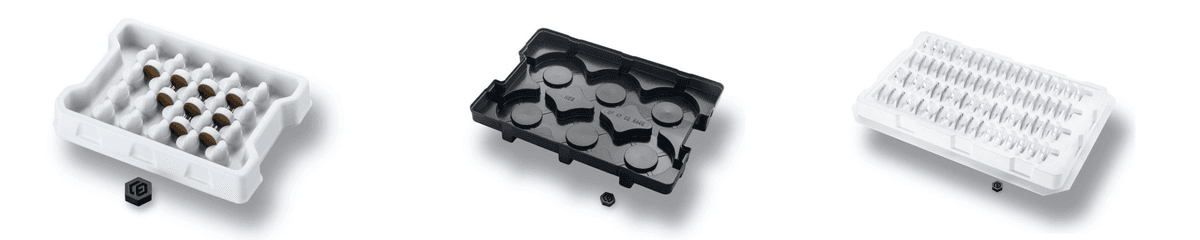
Components are automatically fed into special plastic trays (workpiece carriers)
Trays pass through all processing stages and can accommodate different component variants
Outbound Logistics
Finished parts are transported in precise packaging units
Reusable shuttle packaging can be used for return transport
How are trays used in fully or semi-automated systems?
In automated production systems, trays handle the continuous transport of components, from goods receipt to final removal.
Autonomous circulation: Empty trays are automatically fed into the system, filled or emptied at the processing stations, and discharged again at the end of the production line.
Palletizing systems: Depending on the type of system, drawer systems, tray stackers, or fully automatic palletizers are used. These systems ensure uninterrupted material flow and precise transfer to robots or conveyor technology.
Dimensional and standard adaptation: The tray dimensions are aligned with conveyor belts, robot gripping ranges, and standardized industrial containers. All common standards are stored in the formary database, so that the tray integrates exactly into existing processes.
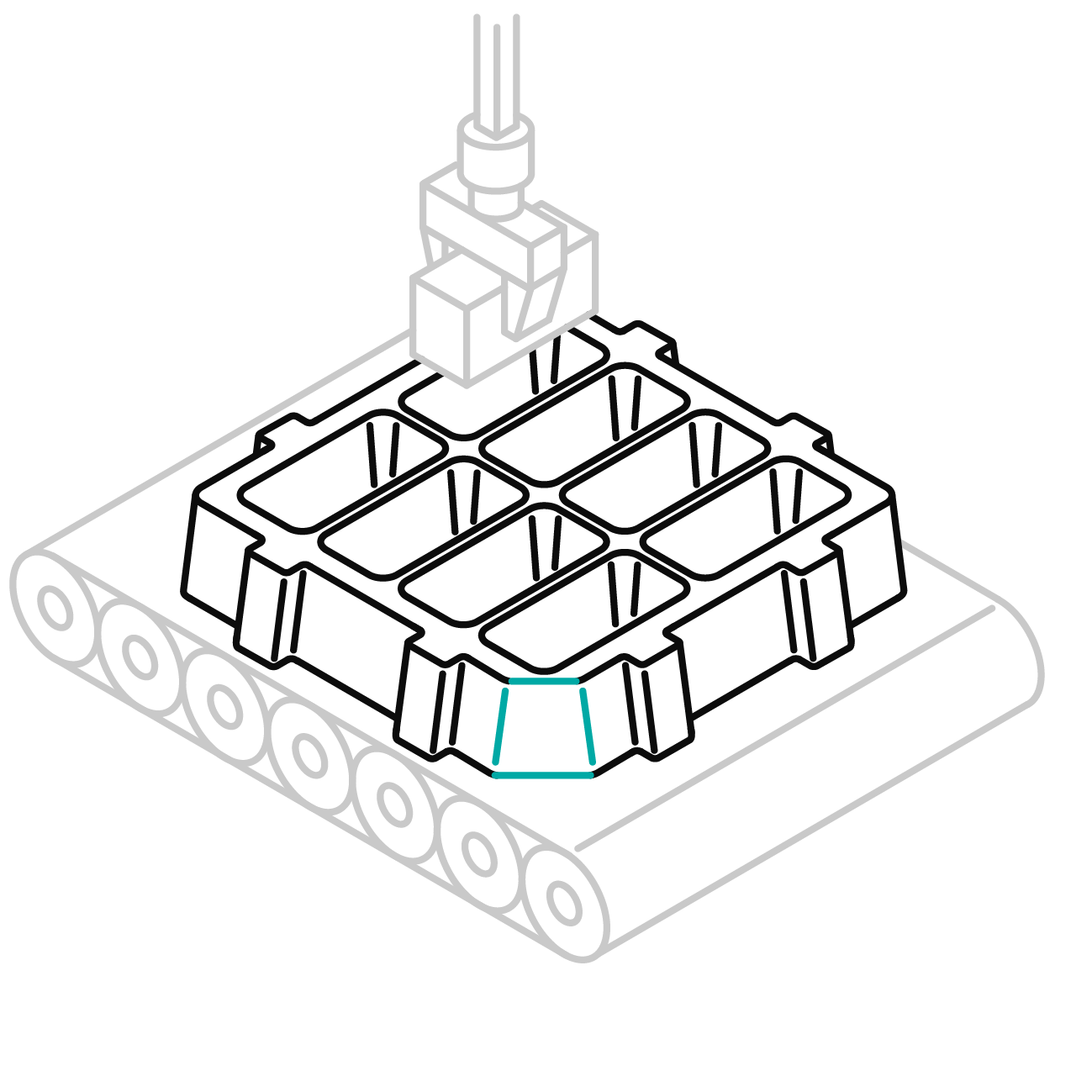
Optimized handling: Shape, outer contours, and gripping areas are designed so that palletizing systems and robotics can safely pick up, stack, and position the trays – even at high cycle rates.
Optimal Tray Design for Automation in Production
There are important design aspects for plastic trays used in production automation:
Form nests: Form nests are suitable for different component shapes and stages
Packing density: Efficient utilization of the tray surface
Poka-Yoke elements: Prevent incorrect installation through clear positioning
Robot gripper adaptation: Nest contour aligned with the stroke of the gripper fingers
Material & stability: Suitable for multiple cycles in production
Tip: If you already have 3D data, you can also visualize it in our 3D Tray Generator. Simply register for free and get started right away.
How Trays Support Further Process Automation
Industrial robots are key in production automation. Primarily, they are responsible for loading and unloading parts in and out of the tray. The edge contour and wall construction depend on the symmetry of the parts and can be supported both visually and mechanically. To position the parts, elements like Poka-Yoke pins can be added to the tray.
Poka-Yoke Edges
Adaptation to the robot
The gripping point on the component must be selected so that the robot arm can grip safely.
Size, weight, and geometry of the component determine the cavity shape in the tray.
The nest contour is adapted to the optimal stroke of the gripper fingers.
The coating of the gripper jaws is based on the respective pick-and-place task.
Different robot systems
Simple grippers work with a fixed motion sequence.
More complex systems have integrated image processing and distance measurement systems to approach contours and components precisely.
Depending on the system used, the permissible tolerance range of the tray varies in interaction with the system.
How does the system capture tray data for production automation?
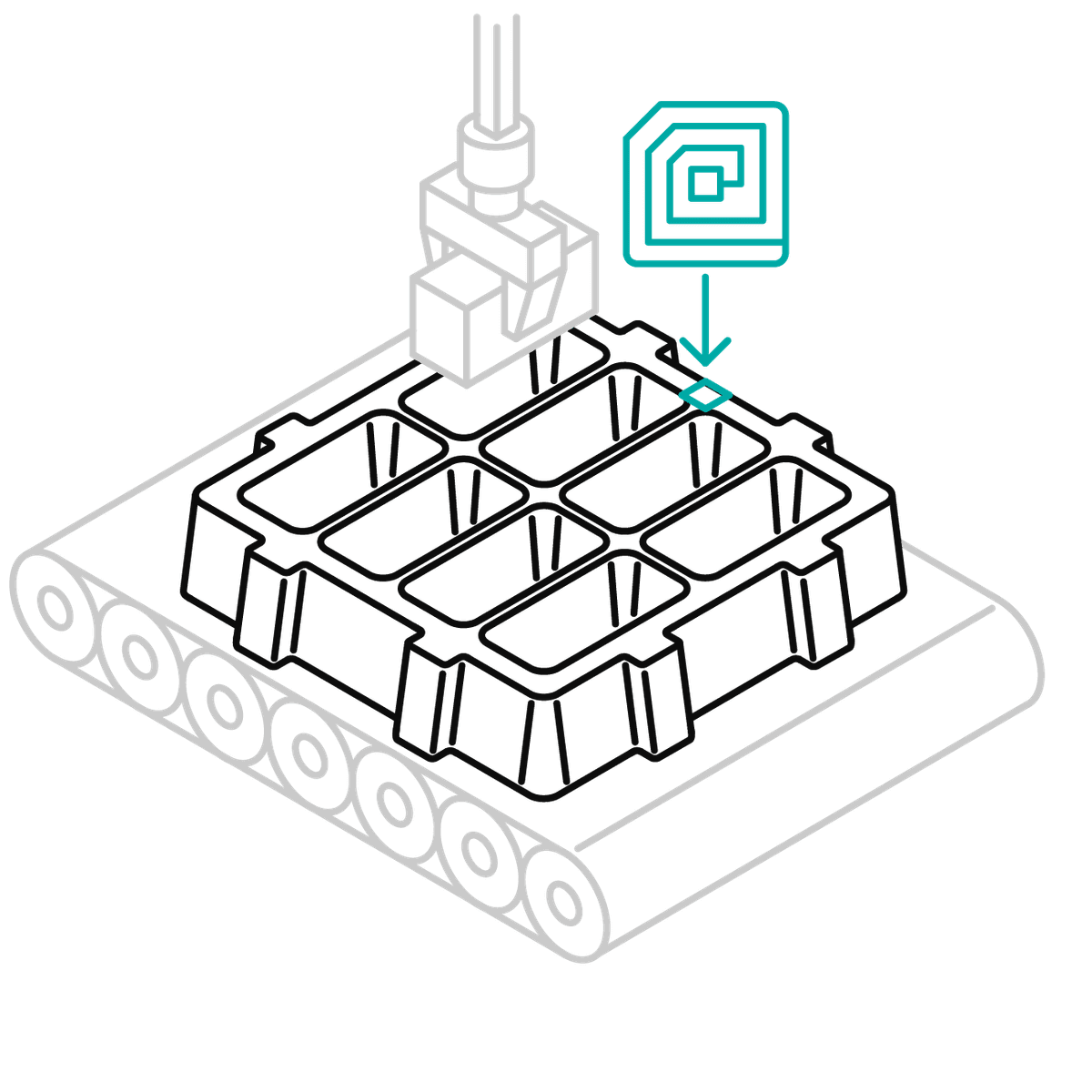
Automation trays can be encoded so that sensors can capture them and collect essential data. Options include binary detection systems in the tray frame and applying markings such as RFID chips, transponders, or fixed engravings that can be recognized and tracked. More information can be found under “Automation Trays.”
Integrated Transponder on the automation tray
Automation of Industry 4.0 Manufacturing through Trays – A Conclusion
The integration of trays into automated manufacturing processes offers an efficient solution to the challenges faced by modern industries. The adaptability to different manufacturing systems, as well as support for robotics, helps increase efficiency and precision. Ultimately, trays for production automation support and optimize Industry 4.0 in many areas.
Save this blog post
You want to continue reading the blog post later or use it on your computer? Download and save now.
Frequently asked questions about using trays for production automation
Yes, multifunctional form nests allow different versions of a component to be accommodated.
Further Content
Thermoformed Parts in Practice
Warehouse Inventory: Tips & Tricks for Better Warehouse Organization and Efficiency with Trays
Warehouse inventories cost time, tie up staff, and often disrupt ongoing operations. This is especially true for small parts, serial components, or recurring components, where counting quickly becomes confusing if parts are stored loose in boxes or shelf compartments. Standard trays create a simple yet effective structure here for better warehouse organization. This article shows how trays optimize inventory counts in both the warehouse and production.
Thermoformed Parts in Practice
Tray Labeling: How to Use Labels Effectively for Your Packaging
To ensure that trays can be correctly identified and used, clear labeling is essential. Depending on the application, quantity, and process requirements, different methods can be used, such as permanent engraving or flexible labels. In this article, you will learn which tray labeling methods are available, when each method makes sense, and how labeling can already be incorporated into the tray design using formary’s 3D Tray Generator.
Thermoformed Parts in Practice
Supplier Guide for Plastic Thermoformed Parts – 10 Key Factors That Matter
Choosing the right supplier for plastic thermoformed parts is crucial for the quality, efficiency, and cost-effectiveness of your production. Our 10 tips will show you what to look for when selecting a supplier.
Platform & Features
3 Factors That Accelerate Your Procurement with formary
The three key factors—time, speed, and efficiency—are crucial for success in industrial manufacturing, from inquiry to delivery. That’s why formary has optimized this process, significantly accelerating the procurement of plastic thermoformed parts. Learn more in this article.
Thermoformed Parts in Practice
Rapid Prototyping in Thermoforming – Definition, Benefits & Processes
Rapid prototyping is used in product development to quickly create preliminary models. In thermoforming, rapid prototyping offers numerous advantages for producing high-quality prototypes efficiently and cost-effectively.
Platform & Features
Project Planning in Thermoforming – From Concept to Mass Production
From the initial idea to mass production, various factors must be considered in thermoforming project planning, including material selection, tool manufacturing, and quality control. This article provides a detailed look at how a thermoforming project with formary is executed.
Thermoformed Parts in Practice
Thermoforming vs. 3D Printing – Advantages, Disadvantages, Differences, and Similarities
Plastic parts are manufactured using various processing methods. In this article, we focus on comparing the processes of plastic thermoforming and 3D printing.
Thermoformed Parts in Practice
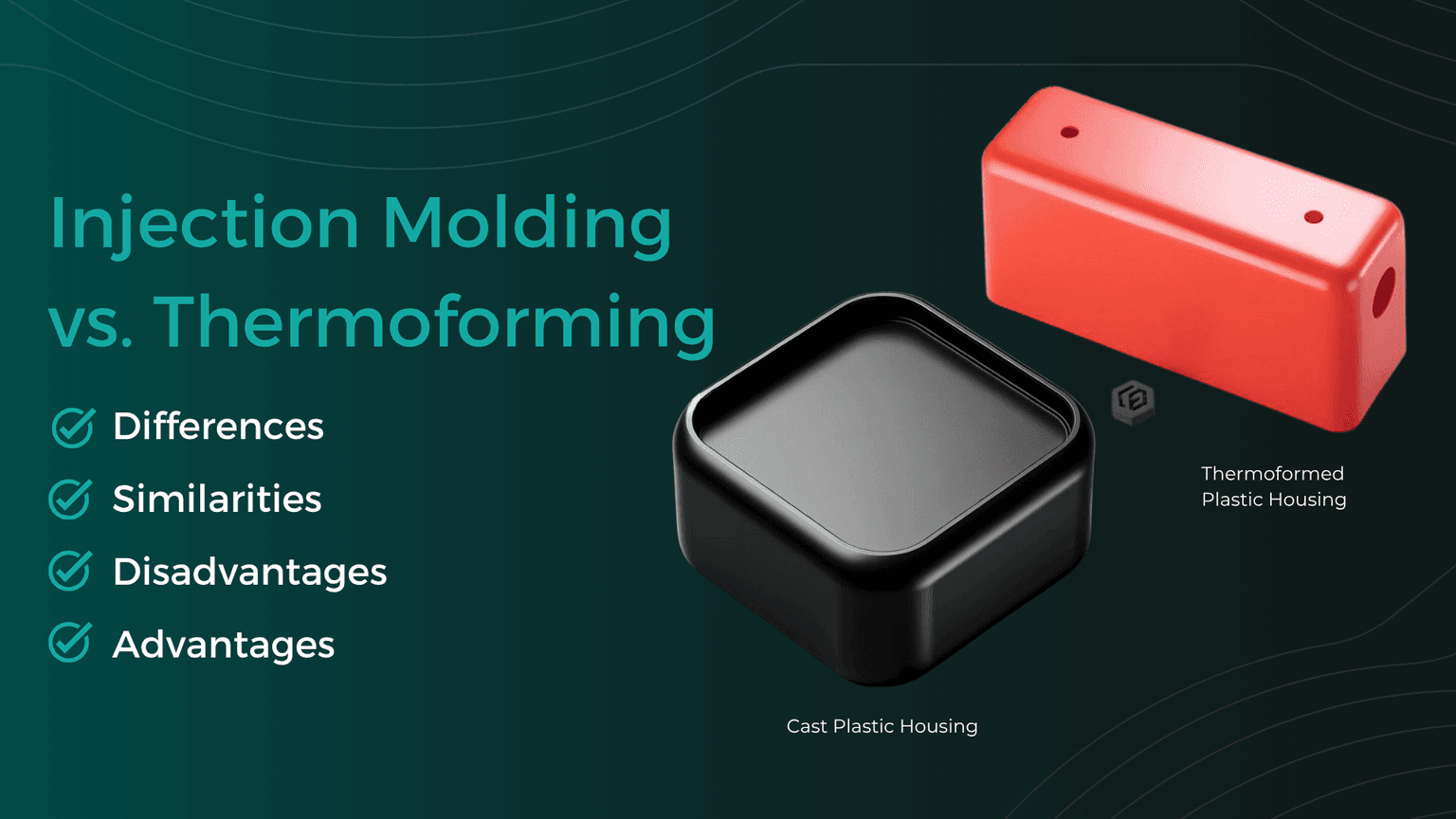
Injection Molding vs. Plastic Thermoforming – Advantages, Disadvantages, Differences, and Similarities
In the world of plastic processing, there are various common manufacturing methods used to produce precise plastic components for industrial applications. We compare two of them: Injection Molding and Plastic Thermoforming.
Thermoformed Parts in Practice
Checking CAD Models for Thermoformability: The Designer's Guide
Whether a plastic part is thermoformable is determined in the CAD model. Anyone who discusses geometry, wall thicknesses, and demoldability only after the first sampling pays for this loop with tool modifications, material waste, and lost weeks in the project timeline. This can be avoided during design: with a structured check that evaluates each model along this guide and makes typical sources of error visible early on.