Cleaning Trays: This is how to clean reusable trays
Workpiece carriers transport components in various stages of production and are used for long periods. Many components, especially in the automotive industry, are oily or greasy, and during transport, dirt and other contaminants accumulate. Therefore, it is important to clean the trays.
Lisa-Marie Bittner
Updated on May 29, 2026
Share
Cleaning trays - Key points at a glance
The design and material selection of plastic trays should consider the cleaning process from the start.
Industrial cleaning processes expose trays to high stresses such as heat, chemicals, and water pressure.
The right material selection, robust construction, and involvement of cleaning experts are crucial for a long service life of the trays.
→ In our 3D Tray Generator, you can add drainage holes to the tray to optimally equip it for washing processes.
How does tray cleaning affect design?
The cleaning of used plastic trays and workpiece carriers usually takes place at the end of the production chain or is even completely separated from the production process and carried out by external service providers. Trays are usually designed with a focus on the production process they are intended to optimize.
Nevertheless, it is important to consider tray cleaning right from the start of development. That's why you can specify washing processes in the configurator when you make your inquiry.
How is a tray cleaned industrially?
Usually, production sites sort out trays that need to be cleaned and place them at a collection point where they are picked up for workpiece carrier cleaning. The cleaning of the trays then takes place either in-house or at an external service provider. Industrial washing systems are used for this purpose.
The cleaning process in the washing system
The designs of washing systems are as diverse as the cleaned articles, workpiece carriers and components. In simplified terms, the washing process usually includes the following steps:
Pre-sorting
Removal of foreign objects (e.g. labels)
Multi-stage washing process according to requirements, e.g.:
Pre-wash zone
Ultrasonic
Spraying
Immersion degreasing
Injection flood washing
High-pressure water jet technology
Drying process
The latter is particularly important for delicate electronic components where residual moisture can quickly lead to corrosion. After the professional cleaning process, the reusable workpiece carriers can be immediately returned to the production cycle.
What does the tray have to withstand during cleaning?
During industrial cleaning, trays are exposed to particular stresses. The choice of the right material and design must withstand these influences. Here are the most important factors:
Effects on the tray during the washing process
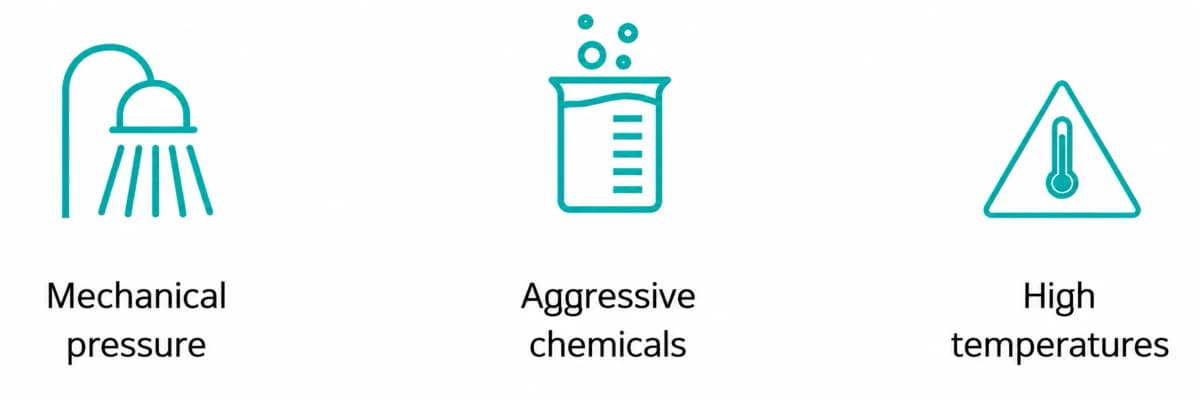
Solvents and chemicals: These are used to remove grease, oils or paints and can have an aggressive effect on the tray surface.
Mechanical high pressure: Water jets can damage delicate contours.
High temperatures: Drying processes, as is common in industrial cleaning, expose the material to high temperatures.
What cleaning techniques are available?
In addition to standard washing processes, there are gentler techniques such as ultrasonic cleaning.
Ultrasonic cleaning: In this method, the workpiece carrier is immersed in a bath that is set into vibrations by sound waves. This creates tiny bubbles that, when they burst, loosen the dirt from the surface. Aggressive chemicals can often be avoided this way.
Drying: Drying can be done via vacuum technology. Drying processes for sensitive components are carried out using warm air circulation systems or contactless, antistatic air purifiers. The possibilities are diverse.
How your tray can survive many washing processes unharmed during cleaning
Since we have already designed many thermoformed trays and workpiece carriers that are suitable for industrial cleaning systems, we can tell you what matters.
1.) The right material selection
For reusable containers, thicker material gauges are generally used to make the tray stable for months or years of use.
Important properties include:
Impact strength
Hardness
Resistance to chemicals and solvents
Only plastics that are not reactive with the cleaning agents used are suitable. Although high-quality plastics are initially more expensive, they quickly pay for themselves through longer service life, stability and consistent quality.
2.) Design must-dos for cleaning-resistant trays
The design should be adapted to the environmental influences of cleaning:
The design is most efficient when the internal or external cleaning service provider is involved from the start. To avoid unwanted chemical reactions, two approaches can be taken:
Starting from the cleaning agent: Service provider names the planned agent, formary checks plastic compatibility.
Starting from the plastic: formary recommends suitable agents that the service provider validates with their system.
This way, unwanted reactions can be avoided and the tray can be optimally prepared for reusable application.
Conclusion: Cleaning begins at the tray design stage
For plastic trays to reliably survive many industrial washing processes, cleaning should not only be considered at the end of the production process. It is crucial that material selection, wall thicknesses, geometry and additional features such as drainage holes are already adapted during design to the subsequent stress from chemicals, temperature, water pressure and drying.
This early planning particularly pays off for reusable trays: the tray remains stable longer, cleaning quality is improved and failures in the production cycle can be avoided.
High-quality plastic trays are made of materials with high impact strength, sufficient hardness and chemical resistance. Only plastics that are stable against cleaning agents and the intended materials guarantee a long service life and consistent quality.
Thick material gauges ensure that reusable trays withstand mechanical stresses and remain in use for months or years. They reduce the risk of breakage or deformation and at the same time contribute to long-term cost-effectiveness, as less replacement is needed.
The design of plastic trays takes into account mechanical stress points and environmental influences. Reinforcements at heavily stressed areas, water-repellent edges and drainage holes in the cavities facilitate cleaning and significantly extend the service life of the tray.
Early involvement of the cleaning service provider ensures that the cleaning agents used and plastic materials are optimally coordinated. This collaboration avoids chemical reactions and makes cleaning processes efficient.
Yes, high-quality plastic trays pay for themselves quickly. They need to be replaced less frequently, retain their stability and quality over a long period and offer both economic and environmental benefits. The investment pays off through reduced maintenance costs and less material consumption.
Further Content
Thermoformed Parts in Practice
Warehouse Inventory: Tips & Tricks for Better Warehouse Organization and Efficiency with Trays
Warehouse inventories cost time, tie up staff, and often disrupt ongoing operations. This is especially true for small parts, serial components, or recurring components, where counting quickly becomes confusing if parts are stored loose in boxes or shelf compartments. Standard trays create a simple yet effective structure here for better warehouse organization. This article shows how trays optimize inventory counts in both the warehouse and production.
Thermoformed Parts in Practice
Tray Labeling: How to Use Labels Effectively for Your Packaging
To ensure that trays can be correctly identified and used, clear labeling is essential. Depending on the application, quantity, and process requirements, different methods can be used, such as permanent engraving or flexible labels. In this article, you will learn which tray labeling methods are available, when each method makes sense, and how labeling can already be incorporated into the tray design using formary’s 3D Tray Generator.
Thermoformed Parts in Practice
Supplier Guide for Plastic Thermoformed Parts – 10 Key Factors That Matter
Choosing the right supplier for plastic thermoformed parts is crucial for the quality, efficiency, and cost-effectiveness of your production. Our 10 tips will show you what to look for when selecting a supplier.
Platform & Features
3 Factors That Accelerate Your Procurement with formary
The three key factors—time, speed, and efficiency—are crucial for success in industrial manufacturing, from inquiry to delivery. That’s why formary has optimized this process, significantly accelerating the procurement of plastic thermoformed parts. Learn more in this article.
Thermoformed Parts in Practice
Rapid Prototyping in Thermoforming – Definition, Benefits & Processes
Rapid prototyping is used in product development to quickly create preliminary models. In thermoforming, rapid prototyping offers numerous advantages for producing high-quality prototypes efficiently and cost-effectively.
Platform & Features
Project Planning in Thermoforming – From Concept to Mass Production
From the initial idea to mass production, various factors must be considered in thermoforming project planning, including material selection, tool manufacturing, and quality control. This article provides a detailed look at how a thermoforming project with formary is executed.
Thermoformed Parts in Practice
Thermoforming vs. 3D Printing – Advantages, Disadvantages, Differences, and Similarities
Plastic parts are manufactured using various processing methods. In this article, we focus on comparing the processes of plastic thermoforming and 3D printing.
Thermoformed Parts in Practice
Injection Molding vs. Plastic Thermoforming – Advantages, Disadvantages, Differences, and Similarities
In the world of plastic processing, there are various common manufacturing methods used to produce precise plastic components for industrial applications. We compare two of them: Injection Molding and Plastic Thermoforming.
Thermoformed Parts in Practice
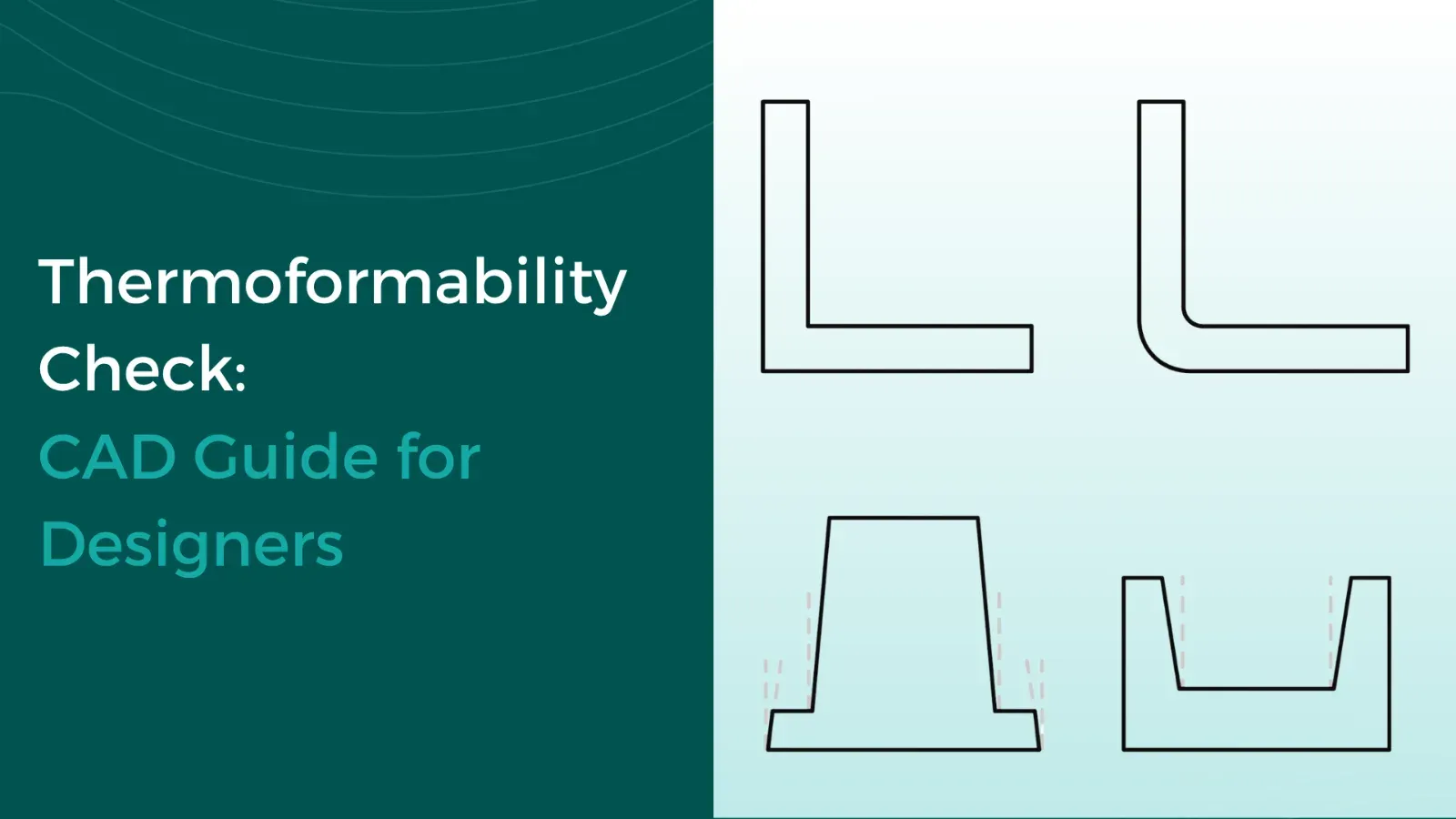
Checking CAD Models for Thermoformability: The Designer's Guide
Whether a plastic part is thermoformable is determined in the CAD model. Anyone who discusses geometry, wall thicknesses, and demoldability only after the first sampling pays for this loop with tool modifications, material waste, and lost weeks in the project timeline. This can be avoided during design: with a structured check that evaluates each model along this guide and makes typical sources of error visible early on.