Surface Finishing for Medical Housings: Function Meets Design
The finishing of medical housing surfaces must meet the highest standards of functionality, hygiene, and design. This blog post will explain how formary uses thermoforming to produce visually appealing and functional medical housings ensuring compliance with regulatory requirements.
Talida Eichhorn
Updated on June 3, 2026
Share
Surface optimization for thermoformed medical housings – Key facts at a glance
Modern surfaces for thermoformed medical housings are created through a combination of materials technology and design and meet the highest standards of functionality and hygiene.
Technical refinements ensure EMC protection, flame retardancy, and UV resistance for reliable and safe use.
What requirements must the surfaces of medical enclosures meet?
The surface treatment of medical covers must withstand mechanical stress and comply with strict standards for electromagnetic compatibility (EMC), fire safety, and hygiene. In addition, the demands on design and haptics are increasing, as devices are increasingly in the field of vision or in direct contact with patients.
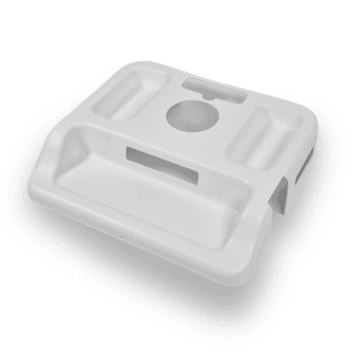
Medical cover for MSOT-Tool
How do technical refinements protect medical devices?
Technical surface refinementsin medical technology ensure that housings function reliably and safely. These include the following surface treatments:
EMC protection: How is unwanted radiation shielded?
EMC protection (electromagnetic compatibility) uses a conductive inner layer to shield unwanted radiation and protect sensitive electronics including ultrasound devices or ECG systems from emissions and electromagnetic interference. This EMC shielding is achieved through specialized coating processes such as conductive paints, electroplating, or vapor deposition.
EMC as an important criteria for medical covers
Flame retardancy: Why is flame resistance so important in medical technology?
Many medical plastic housings must comply with the UL94 V0 classification and self-extinguish within seconds in the event of a fire.
Which plastics offer flame retardancy?
Plastic housings made from material blends such as ABS-PC combinations combine the superior mechanical properties of polycarbonate with the lower processing temperature and moldability of ABS and are ideal for flame retardancy. This ensures that safety standards are met with optimal functionality, even for large cladding components.
UV protection: How is the long service life of medical housings guaranteed?
Medical devices are often exposed to intense lighting or direct sunlight, but can be protected by UV-resistant plastics. UV-stabilized plastics such as ASA or ABS prevent surfaces from yellowing, becoming brittle, or losing their mechanical properties over time. This ensures long-lasting functionality and appearance, even with intensive use.
What are the advantages of optical refinements in medical technology?
The surface of medical cladding components is much more than just a design element. It is crucial for functionality, hygiene, and user-friendliness. Cladding should not only look good but also integrate seamlessly into sterile, functional environments. The advantages:
Ease of use: Color, finish, and texture influence the ease of use and visual impact of a medical device, especially in clinical environments.
Recognition: CI-compliant color schemes and precise prints ensure recognition and serve as orientation aids.
Direct coloring for series production
For CI-compliant colors and logos on medical technology housings, various color options can already be integrated in the material during production for larger quantities. The desired RAL shade is extruded directly into the plastic material using so-called masterbatches. The process is cost-efficient, but requires a minimus material volume (1-5 tons).
Color options for medical housings directly through pre-colored materials or painting
In which cases should paint finishes be used?
For smaller batch sizes, prototypes, or individual customer requirements, paint finishes offer maximum flexibility even for quantities as low as one.
Metallic, matte, or effect paints serve to protect the surface and enhance its appearance, for example by reducing reflections.
Film coatings such as polished metal or chrome create attractive designs to achieve a modern, easy-to-clean, and high-quality look.
Further options for surface finishing of medical plastic housings
In addition to painting and coating, the thermoforming process itself offers opportunities for targted surface design. For example, textures and patterns can be engraved directly into the tooling. This allows fine leather-like patterns, grooves, or microtextures to be transferred to the component surface during forming.
The result: glare-free, non-slip, and easy-to-clean surfaces that are ideal for surgical environments or diagnostic workstations.
What advantages do functional finishes offer for medical enclosures?
Beyond design and safety, medical device surfaces must also meet specific functional requirements. These include:
Electroplating: Electroplated metal layers enhance electrical conductivity and mechanical strength. This is important for enclosure components that require electrical conductivity or must withstand high mechanical loads.
Vapor-deposited and uniformly metallized surfaces: These provide a high-quality, decorative appearance, as is often required for bezels or decorative panels in medical devices.
Antimicrobial additives: Antimicrobial additives such as silver ions, zinc oxide, or copper-based solutions reduce germ contamination.
Fluorination & gamma irradiation: Processes such as fluorination or gamma irradiation specifically alter surface properties.
However, it is important to note: Such additives do not replace regular cleaning, which is why resistance to disinfectants is a key criterion in the selection of materials.
Color options for medical housings directly through pre-colored materials or painting
Optimize the surface of your medical device housing now
The surface defines more than just the appearance: it also affects hygiene, safety, functionality, and user experience. With the right materials and processes from formary, you get functional and economically viable solutions for thermoformed components used in medical applications.
Request your thermoformed medical housings directly through the formary configurator and kick-tart your next project.
Frequently asked questions about surface finishing in medical technology
Surface finishing refers to the targeted treatment of plastic surfaces to optimize properties such as conductivity, texture, and appearance. This makes thermoformed medical housings more durable, safer, and easier to use.
Polycarbonate (PC), ABS, and ASA are among the plastics suitable for medical technology housings, with material blends such as ABS-PC combinations being particularly common.
The choice of the appropriate finish depends on the application environment, quantity, and design and functional requirements. formary will advise you individually on this.
Further Resources
Thermoformed Parts in Practice
Warehouse Inventory: Tips & Tricks for Better Warehouse Organization and Efficiency with Trays
Warehouse inventories cost time, tie up staff, and often disrupt ongoing operations. This is especially true for small parts, serial components, or recurring components, where counting quickly becomes confusing if parts are stored loose in boxes or shelf compartments. Standard trays create a simple yet effective structure here for better warehouse organization. This article shows how trays optimize inventory counts in both the warehouse and production.
Thermoformed Parts in Practice
Tray Labeling: How to Use Labels Effectively for Your Packaging
To ensure that trays can be correctly identified and used, clear labeling is essential. Depending on the application, quantity, and process requirements, different methods can be used, such as permanent engraving or flexible labels. In this article, you will learn which tray labeling methods are available, when each method makes sense, and how labeling can already be incorporated into the tray design using formary’s 3D Tray Generator.
Thermoformed Parts in Practice
Supplier Guide for Plastic Thermoformed Parts – 10 Key Factors That Matter
Choosing the right supplier for plastic thermoformed parts is crucial for the quality, efficiency, and cost-effectiveness of your production. Our 10 tips will show you what to look for when selecting a supplier.
Platform & Features
3 Factors That Accelerate Your Procurement with formary
The three key factors—time, speed, and efficiency—are crucial for success in industrial manufacturing, from inquiry to delivery. That’s why formary has optimized this process, significantly accelerating the procurement of plastic thermoformed parts. Learn more in this article.
Thermoformed Parts in Practice
Rapid Prototyping in Thermoforming – Definition, Benefits & Processes
Rapid prototyping is used in product development to quickly create preliminary models. In thermoforming, rapid prototyping offers numerous advantages for producing high-quality prototypes efficiently and cost-effectively.
Platform & Features
Project Planning in Thermoforming – From Concept to Mass Production
From the initial idea to mass production, various factors must be considered in thermoforming project planning, including material selection, tool manufacturing, and quality control. This article provides a detailed look at how a thermoforming project with formary is executed.
Thermoformed Parts in Practice
Thermoforming vs. 3D Printing – Advantages, Disadvantages, Differences, and Similarities
Plastic parts are manufactured using various processing methods. In this article, we focus on comparing the processes of plastic thermoforming and 3D printing.
Thermoformed Parts in Practice
Injection Molding vs. Plastic Thermoforming – Advantages, Disadvantages, Differences, and Similarities
In the world of plastic processing, there are various common manufacturing methods used to produce precise plastic components for industrial applications. We compare two of them: Injection Molding and Plastic Thermoforming.
Thermoformed Parts in Practice
Checking CAD Models for Thermoformability: The Designer's Guide
Whether a plastic part is thermoformable is determined in the CAD model. Anyone who discusses geometry, wall thicknesses, and demoldability only after the first sampling pays for this loop with tool modifications, material waste, and lost weeks in the project timeline. This can be avoided during design: with a structured check that evaluates each model along this guide and makes typical sources of error visible early on.