What is Pneumatic Forming? A Quick Guide to Shaping Plastic with Compressed Air
Pneumatic forming is a widely used technique for shaping thermoformed parts from rolls or sheets. This process utilizes compressed air to apply greater force during the forming stage, ensuring precise shaping and efficient production.
Find out how pneumatic forming works and the key advantages it offers in this article.
Sarah Guaglianone
Updated on June 3, 2026
Share
Pneumatic forming – key facts at a glance
Pneumatic forming uses heated material and additional compressed air for precise shaping. It requires robust tooling, often made of aluminium, and a bottom-up approach when building up pressure.
Advantages: sharper contours, improved material distribution, lower risk of chill marks, shorter cycle times and suitability for high-volume production.
Pneumatic forming is particularly suitable for demanding thermoforming projects, such as transparent parts, engineering plastics or pre-printed components, despite higher tooling and energy costs compared with vacuum forming.
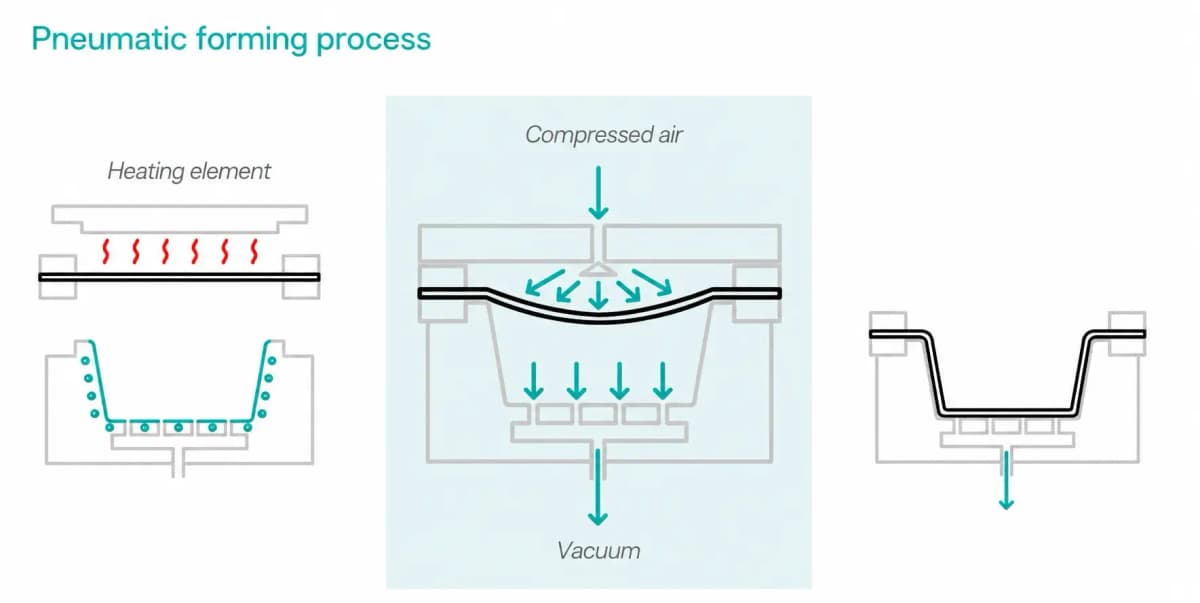
Pneumatic forming is a specialised process used in plastic thermoforming and the twin-sheet process. In this method, the heated material is pressed precisely against the tool using additional compressed air. This produces components with particularly sharp contours, uniform wall thicknesses and high precision.
In pneumatic forming, the heated semi-finished material, either sheet or roll material, is pressed against the tool using compressed air. Since high forces are involved, robust aluminium tools are required. Prototype materials such as Ureol or synthetic resins cannot withstand the pressure and could damage the machine.
Process steps in pneumatic forming
Heating the material: The plastic is brought to forming temperature.
Pressure build-up: The process starts with low pressure, which is then gradually increased (“bottom-up”) until the optimum forming result is achieved.
Forming: Compressed air presses the plastic precisely into the cavity.
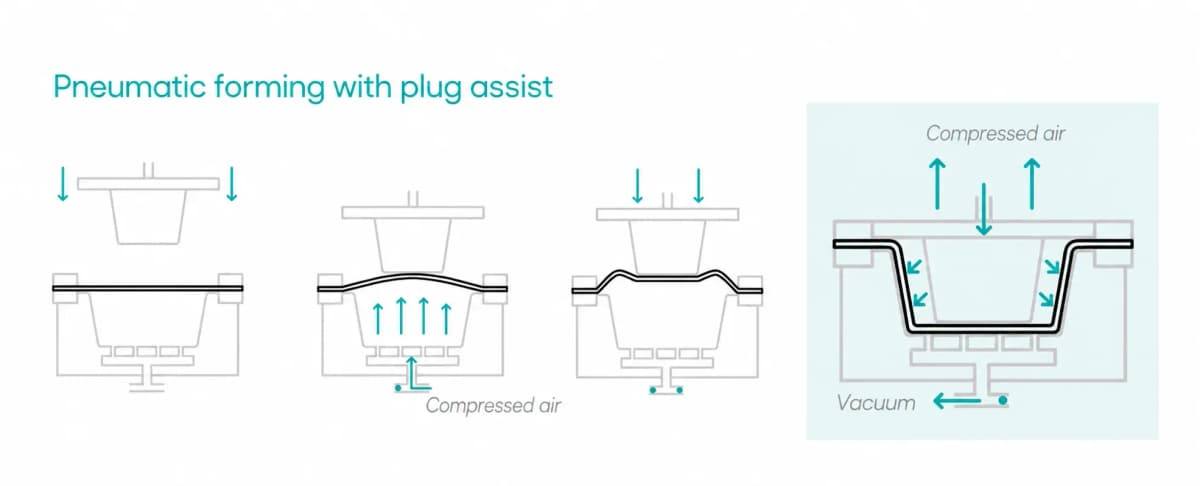
Optional pre-stretching: Bubble forming or the use of a plug assist can help achieve uniform wall thicknesses.
Cooling and removal: The part is released from the tool and is ready for further processing.
ℹ️ A bottom-up approach is important for achieving the optimum forming pressure during hot forming with compressed air. This means starting with low pressure and gradually increasing it as needed. The pressure should only be as high as necessary to achieve sharp forming of the moulded part. Excessive pressure increases lead to wasted energy and, at the same time, increase the risk of tool damage during production.
Special processes in pneumatic forming
Pneumatic forming enables the use of specific forming techniques to control wall thickness distribution and geometries in a targeted way.
Pre-stretch bubble: Before the vacuum and plug assist are applied, a bubble can be formed to pre-stretch the heated material.
Snapback process: The snapback process works with additional compressed air from the lower table.
Advantages and limitations of pneumatic forming
Although pneumatic forming machines are more expensive to purchase, the process offers key advantages in terms of precision, cycle time and material distribution.
Advantages of pneumatic forming
Shorter heating and cooling times: The process control significantly reduces cycle times. This lowers unit costs, especially for high production volumes.
Lower risk of material sagging: Since lower forming temperatures are used, the material remains stable. The additional forming pressure supports precise forming.
Sharp contours and uniform wall thicknesses: Pneumatic forming optimises contour definition and improves material distribution. At the same time, the risk of chill marks on the surface is reduced.
Suitable for high quantities: Higher tooling costs amortise quickly when the system is used for large series.
Meets high visual and mechanical requirements: The process is ideal for transparent parts and engineering plastics such as PC, polycarbonate, which require high temperature resistance. Pre-printed parts can also be formed much more cleanly with pneumatic forming than with pure vacuum forming.
Disadvantages of pneumatic forming
Higher tooling costs than vacuum forming
Higher energy consumption due to pressure build-up
Overview of the advantages and disadvantages of pneumatic forming
Advantages of pneumatic forming
Disadvantages of pneumatic forming
Sharper contour definition than vacuum forming
Higher tooling costs than with vacuum forming
Lower risk of chill marks
Higher energy costs than with vacuum forming
High temperature resistance
/
Shorter cycle times
/
Suitable for large quantities
/
Pneumatic forming – conclusion
Pneumatic forming is an effective method for precise and economical thermoforming of plastics. The combination of targeted compressed air application and robust tools enables sharp forming. Despite higher initial investments, pneumatic forming machines offer advantages over vacuum forming machines thanks to shorter cycle times and higher temperature resistance.
Pneumatic forming is particularly suitable for projects with high quantities and demanding requirements, such as transparent engineering plastics or pre-printed parts. This makes pneumatic forming a cost-efficient, high-quality solution. Do you want to get started with your thermoforming project? Then submit your request now via our configurator!
Frequently asked questions about pneumatic forming
Pneumatic forming is a specialised plastic thermoforming process in which heated thermoplastic material is pressed against the contours of a tool using targeted air pressure. A bottom-up approach ensures uniform material distribution, high detail accuracy and precise forming, even with complex geometries.
Compared with vacuum forming, pneumatic forming enables sharper contour definition, better material distribution, a lower risk of chill marks and shorter cycle times. Especially for high quantities or demanding components such as transparent parts, engineering plastics or pre-printed parts, the pneumatic forming process is the more efficient solution.
Pneumatic forming is ideal for demanding thermoforming projects with high visual and mechanical requirements, such as transparent parts, engineering plastics, for example polycarbonate, or pre-printed parts. Durable prototypes and series parts also benefit from the high precision of pneumatic forming.
Pneumatic forming usually uses robust aluminium tools, as these can withstand the high forming pressure. Plastic or Ureol tools are often not stable enough.
Pneumatic forming is more cost-intensive than vacuum forming, both in terms of tooling and energy consumption. Despite the higher initial investment, the process quickly pays off for large quantities, as it offers shorter cycle times, more precise formed parts and better material distribution.
Further Resources
Thermoformed Parts in Practice
Warehouse Inventory: Tips & Tricks for Better Warehouse Organization and Efficiency with Trays
Warehouse inventories cost time, tie up staff, and often disrupt ongoing operations. This is especially true for small parts, serial components, or recurring components, where counting quickly becomes confusing if parts are stored loose in boxes or shelf compartments. Standard trays create a simple yet effective structure here for better warehouse organization. This article shows how trays optimize inventory counts in both the warehouse and production.
Thermoformed Parts in Practice
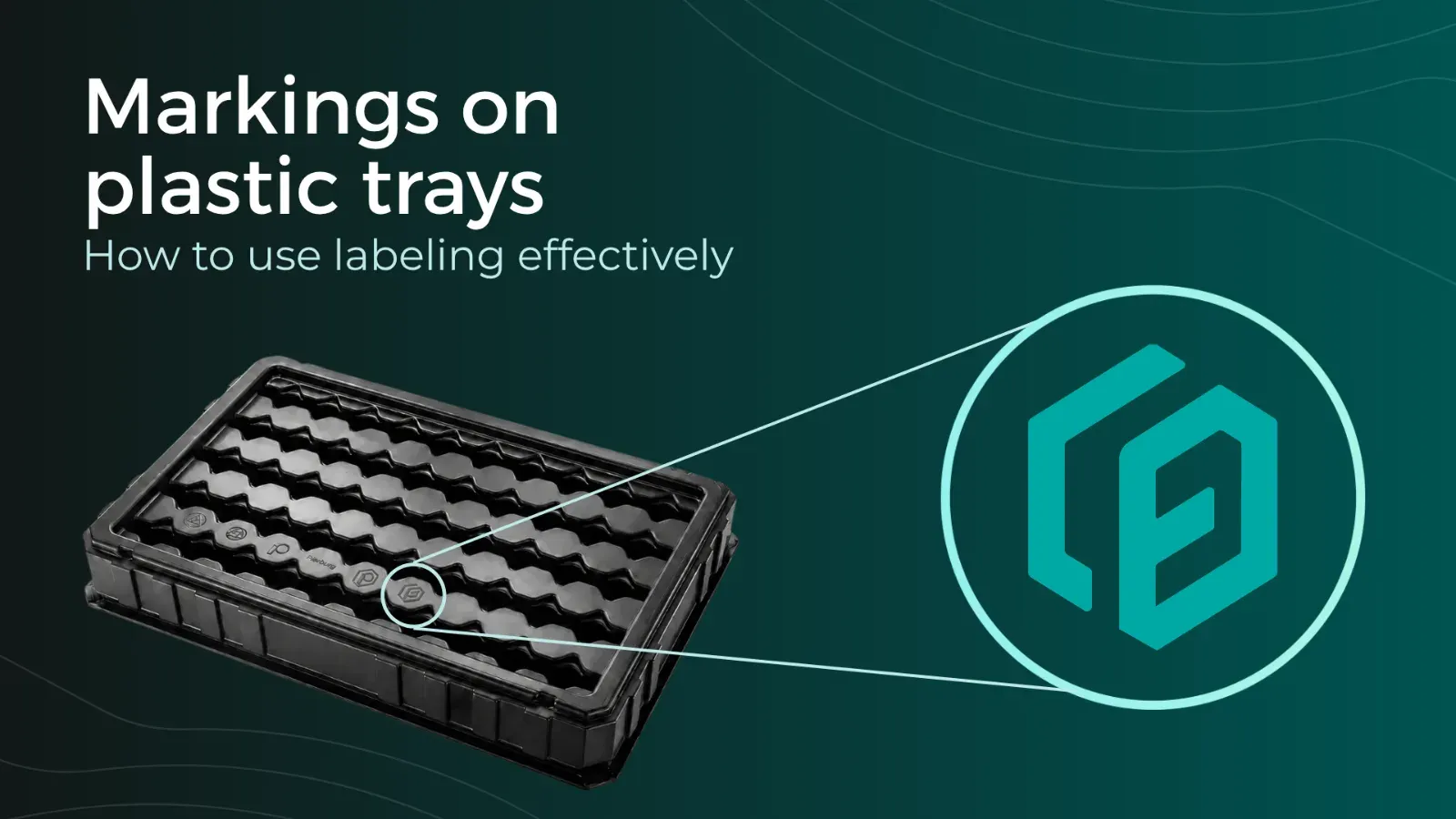
Tray Labeling: How to Use Labels Effectively for Your Packaging
To ensure that trays can be correctly identified and used, clear labeling is essential. Depending on the application, quantity, and process requirements, different methods can be used, such as permanent engraving or flexible labels. In this article, you will learn which tray labeling methods are available, when each method makes sense, and how labeling can already be incorporated into the tray design using formary’s 3D Tray Generator.
Thermoformed Parts in Practice
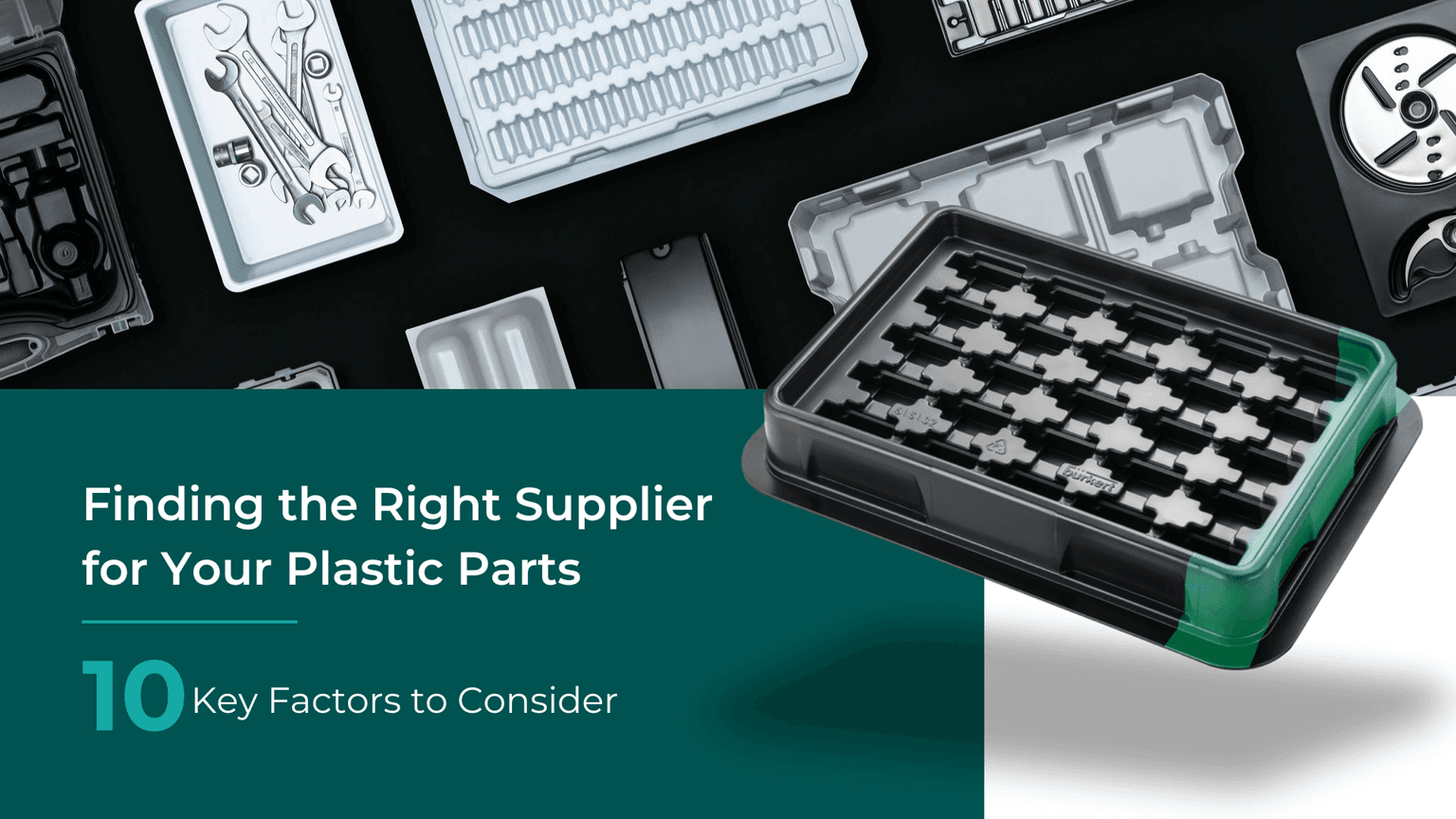
Supplier Guide for Plastic Thermoformed Parts – 10 Key Factors That Matter
Choosing the right supplier for plastic thermoformed parts is crucial for the quality, efficiency, and cost-effectiveness of your production. Our 10 tips will show you what to look for when selecting a supplier.
Platform & Features
3 Factors That Accelerate Your Procurement with formary
The three key factors—time, speed, and efficiency—are crucial for success in industrial manufacturing, from inquiry to delivery. That’s why formary has optimized this process, significantly accelerating the procurement of plastic thermoformed parts. Learn more in this article.
Thermoformed Parts in Practice
Rapid Prototyping in Thermoforming – Definition, Benefits & Processes
Rapid prototyping is used in product development to quickly create preliminary models. In thermoforming, rapid prototyping offers numerous advantages for producing high-quality prototypes efficiently and cost-effectively.
Platform & Features
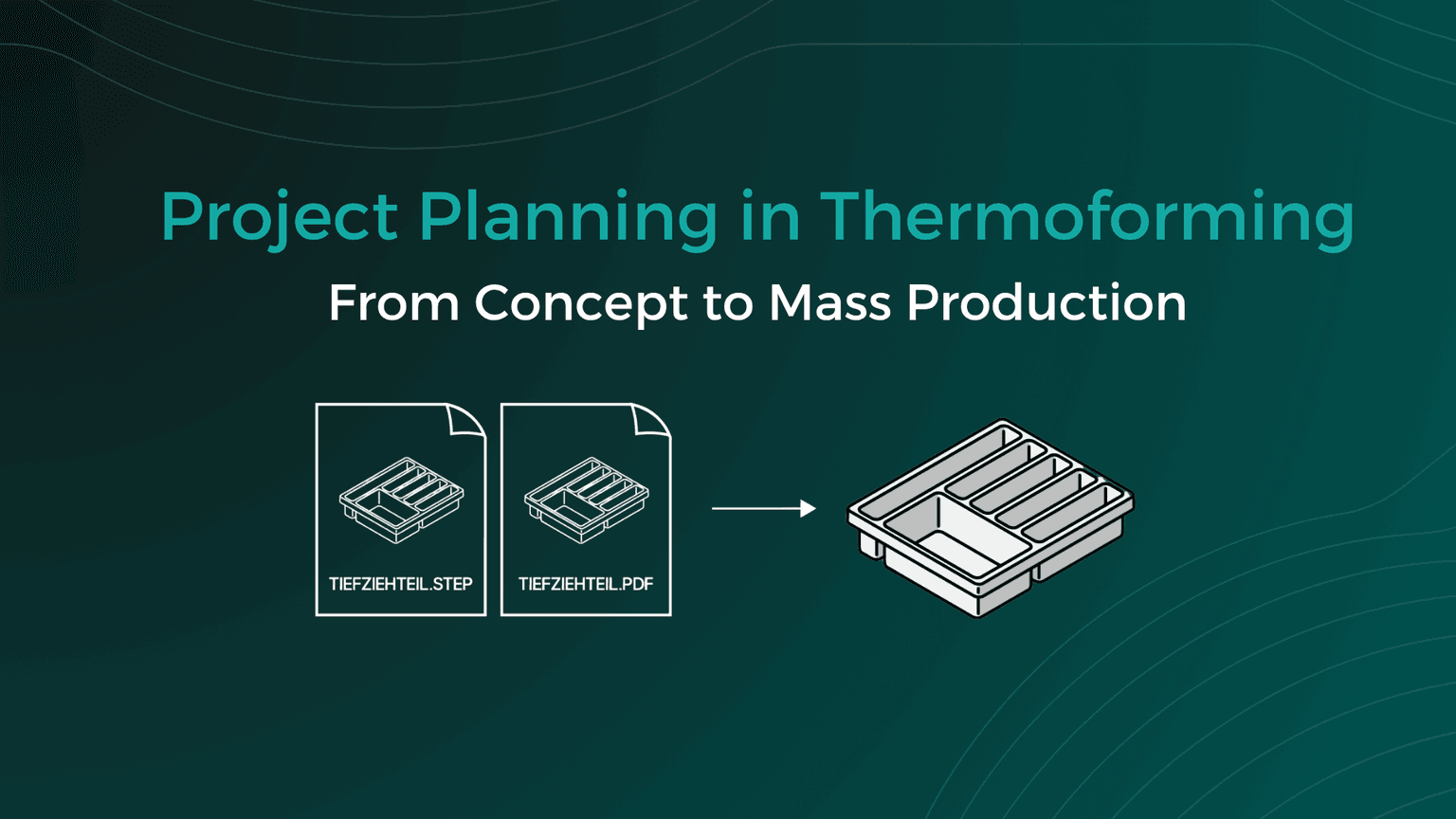
Project Planning in Thermoforming – From Concept to Mass Production
From the initial idea to mass production, various factors must be considered in thermoforming project planning, including material selection, tool manufacturing, and quality control. This article provides a detailed look at how a thermoforming project with formary is executed.
Thermoformed Parts in Practice
Thermoforming vs. 3D Printing – Advantages, Disadvantages, Differences, and Similarities
Plastic parts are manufactured using various processing methods. In this article, we focus on comparing the processes of plastic thermoforming and 3D printing.
Thermoformed Parts in Practice
Injection Molding vs. Plastic Thermoforming – Advantages, Disadvantages, Differences, and Similarities
In the world of plastic processing, there are various common manufacturing methods used to produce precise plastic components for industrial applications. We compare two of them: Injection Molding and Plastic Thermoforming.
Thermoformed Parts in Practice
Checking CAD Models for Thermoformability: The Designer's Guide
Whether a plastic part is thermoformable is determined in the CAD model. Anyone who discusses geometry, wall thicknesses, and demoldability only after the first sampling pays for this loop with tool modifications, material waste, and lost weeks in the project timeline. This can be avoided during design: with a structured check that evaluates each model along this guide and makes typical sources of error visible early on.