Rapid Prototyping in Thermoforming – Definition, Benefits & Processes
Rapid prototyping is used in product development to quickly create preliminary models. In thermoforming, rapid prototyping offers numerous advantages for producing high-quality prototypes efficiently and cost-effectively.
Sarah Guaglianone
Updated on August 31, 2026
Share
Rapid Prototyping in Deep Drawing – The Key Points at a Glance
Rapid prototyping in deep-drawing speeds up development and reduces tooling changeover costs.
There are four rapid prototyping methods used in deep drawing: 3D printing, urethane, partial-segment molds and production molds.
Rapid prototyping is used in particular in the sectors of the automotive, medical technology, robotics and packaging industries.
Rapid Prototyping, also known as Fast Prototyping, refers to the process of quickly and efficiently creating physical models or prototypes of a component or assembly based on three-dimensional CAD/construction data. The prototype serves as the first version of the product, which is thoroughly tested and revised if necessary before mass production.
What is the Purpose of Rapid Prototyping?
Speed: Rapid Prototyping enables the production of prototypes in the shortest possible time, significantly accelerating the development process.
Flexibility: The process allows for quick modifications and corrections to prototypes, improving the final product.
Shorter Time-to-Market: The production and delivery of prototypes are significantly shortened, allowing products to be launched faster.
Benefits of Rapid Prototyping
Early detection of design improvements
Cost efficiency
High precision through computer-aided design
Reduced risk of costly errors
Ability to present physical prototypes and gather feedback
Cost-effective integration of customer requirements
What Types of Rapid Prototyping Methods Exist in Thermoforming?
There are four primary Rapid Prototyping methods in thermoforming, depending on the purpose of the sample.
Process
Sample Lead Time
Number of Samples
3D-Printed Mold
3-5 days
1-3 pieces
Ureol Mold
1-2 weeks
5-10 pices
Partial-Segment Production Mold
2-3 weeks
unlimited
Production Mold
2-10 weeks
unlimited
Prototypes for Thermoformed Parts: An Overview of Processes and Lead Times
The following sections provide an overview of these methods.
Rapid Prototyping with 3D-Printed Molds
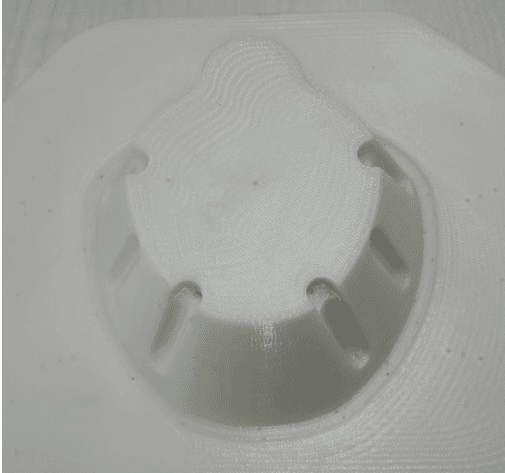
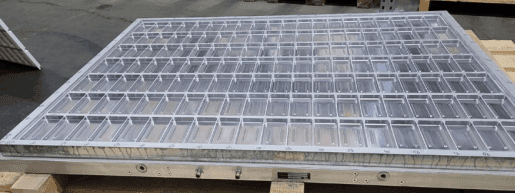
Using 3D-printed thermoforming molds is common for testing critical segments of thermoforming processes. However, due to the high temperatures and mechanical stresses involved in thermoforming, only a small number of samples can be produced from a 3D-printed mold.
3D-Printed Prototypes
Maximum number of samples: 1-3 pieces
Production time (best case): 3-5 working days
Cost:€€€€€
Application Areas:
Testing form-fit accuracy of tray cavities
Rapid production of prototypes within a few days
Small batch production in standard material
Advantages vs. Disadvantages of 3D-Printed Molds
The benefits of rapid prototyping using 3D printing
Disadvantages of rapid prototyping using 3D printing
3D-printed tools are often cost-effective
Depending on the process used, 3D-printed parts have a distinctive surface texture which will be visible on the surface of the deep-drawn part if left untreated. Optical parts are therefore almost automatically ruled out for testing or demonstration purposes. Furthermore, the layered process used in FDM does not allow for the creation of realistic edges and radii, which further diminishes the results’ significance
Rapid fit testing of tray mold cavities
Some materials, such as PP, can only be molded to the highest standard using temperature-controlled production molds
Rapid Prototyping with Ureol Sample Molds
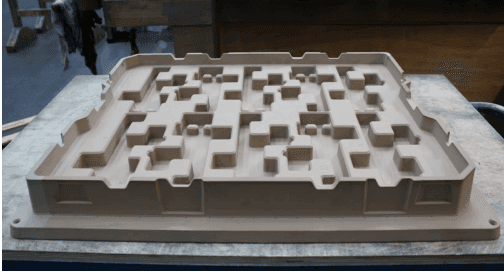
Ureol is a molding material used in model making. molds made from Ureol can be used to produce either individual components or the entire finished product. The result often closely resembles mass-produced deep-drawn parts made using aluminium molds.
Although the milling times for producing Ureol molds are comparable to those for aluminium, the material is more cost-effective. However, due to Ureol’s lower heat and pressure resistance, only a limited number of samples can be produced.
Ureol Tool Prototypes
Maximum number of samples: 5-10 pieces
Production time (best case): 1-2 weeks
Cost:€€€€€
Applications of Ureol Tool Prototypes
The result is a prototype optimised for 3D printing, which takes only slightly longer to produce and costs only slightly more.
Overview of the advantages and disadvantages of rapid prototyping using Ureol molds
Advantages of rapid prototyping with sample tools made from Ureol
Disadvantages of rapid prototyping with sample tools made of ureol
The samples produced are almost ready for series production, but show slight differences in quality compared to aluminum tools.
Additional costs: The Ureol tool only serves as an intermediate step prior to the production of the series tool.
The price is only about 20-30% of the price of a production tool, depending on the contour and complexity of the milling work.
The series tool is only manufactured after approval, which extends the project schedule by another 2-3 weeks.
Rapid Prototyping Using a Partial-Segment Production Mold
A single-cavity aluminium die provides an optimal reproduction of your deep-drawn part and offers cost savings compared to mass production. This can be achieved, for example, by using a simple die instead of a multi-cavity die.
Please note: The prototype mold is an intermediate step towards the production aluminium mold, and the additional time required for its manufacture must be taken into account in the project planning.
Sub-Segment Production Tool Prototypes
Maximum number of samples: unlimited
Production time (best-case scenario): 2–3 weeks
Price: €€€€€
Areas of Application: Sub-Segment-Poduction Tooling and Prototypes
Testing a sub-segment using production-specification molds yields the most realistic indication of the final production result. Where possible, the lessons learnt should be generalisable from the sub-segment to the entire tray.
Overview of the advantages and disadvantages of rapid prototyping using partial-segment production molds
Advantages of rapid prototyping using partial-segment tools
Disadvantages of rapid prototyping using partial-segment tools
Closely replicates serial production quality
Additional production step delays final mold approval by 2-3 weeks
More affordable than a full-scale production mold
/
Can be adjusted for final production after approval
/
Rapid Prototyping with Series Production Tools
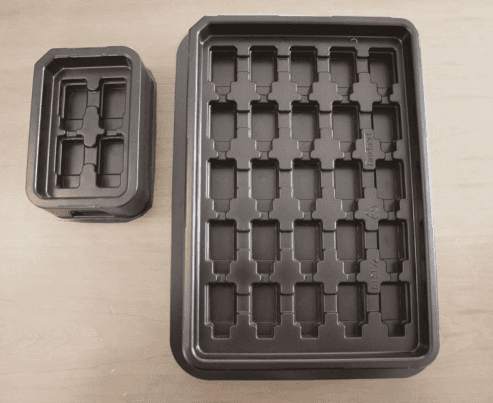
The aluminum series production tool is also used to manufacture release samples. The deep-drawn parts produced using this tool are manufactured under optimal conditions in terms of elongation, heat, and cooling behavior.
The production rate per unit of time is a decisive factor in terms of price, particularly for medium to high production volumes, which is why large multi-purpose tools are often used.
Production Tool Prototypes
Maximum number of samples: unlimited
Production lead time (best-case scenario): 2–6 weeks (depending on size, design and number of compartments; up to 10 weeks may be required for special components)
Price: €€€€€
Applications of Production Tool Prototypes
In terms of production time, production tooling is, of course, the prototyping method that takes the longest. It is therefore primarily used to approve the production product prior to the start of series production – not necessarily for the empirical identification of areas relevant to testing, as with prototype variants 1–3.
Overview of the advantages and disadvantages of rapid prototyping using production tools
Advantages of rapid prototyping using production tools
Disadvantages of rapid prototyping using production tools
High-quality production of deep-drawn parts
Potential costs for reworking the production mold
No additional tooling costs before the start of series production
Production molds take the longest to manufacture, so it is advisable to opt for a simplified version when samples are needed urgently
Samples are usually included in the price of the production mold
/
Saves time, as no additional approval steps are required
/
Rapid Prototyping Applications
Rapid prototyping using deep-drawing is used in a wide range of industries, including:
Automotive: Prototypes of vehicle components such as dashboards, door panels and bumpers can be produced quickly and cost-effectively.
Medical technology: The production of prototypes of medical devices and housings enables manufacturers to develop and test new products quickly.
Packaging industry: Prototypes of packaging and plastic containers can be produced to test their functionality and aesthetics before they go into mass production.
Robotics: In robotics, the deep-drawing process enables high-speed prototyping, with the ability to make adjustments quickly.
ℹ️ Would you like to find out more about the applications of thermoformed parts? Then read our article Thermoformed plastic parts in use.
Rapid Prototyping in Deep Drawing – A Summary
Rapid prototyping in deep drawing offers a wide range of options for producing high-quality prototypes of parts and components quickly and cost-effectively. By combining speed and flexibility, the rapid prototyping process streamlines product development and enables formary to bring innovative products to market more quickly.
Rapid prototyping in thermoforming is the rapid production of plastic prototypes based on 3D CAD data to test form, fit, and function prior to mass production.
3D-printed tools are only suitable for representative samples to a limited extent, as they differ from the series production process in several ways:
Main differences:
Surface quality: The layer structure of 3D printing is transferred to the thermoformed part, which means that visually representative series parts cannot be realistically reproduced this way.
Geometry: FDM processes do not produce edges and radii as precisely as milled series tools.
Temperature control: 3D-printed tools cannot be temperature-controlled, which leads to different results, especially with materials such as PP.
Durability: Only 1–3 samples are usually possible, as the tool cannot withstand the temperatures and loads for long.
For series-like approval samples, a series tool made of aluminum is therefore recommended. It provides realistic results in terms of surface quality, stretch behavior and material properties.
Depending on the tooling option, sample parts are available in as little as 3–5 business days (3D-printed tool, 1–3 pieces). For samples closer to production quality using a Ureol tool, expect 1–2 weeks (5–10 pieces); for partial-segment or production tools, expect 2–6 weeks with an unlimited number of samples.
Related content
Thermoformed Parts in Practice
Warehouse Inventory: Tips & Tricks for Better Warehouse Organization and Efficiency with Trays
Warehouse inventories cost time, tie up staff, and often disrupt ongoing operations. This is especially true for small parts, serial components, or recurring components, where counting quickly becomes confusing if parts are stored loose in boxes or shelf compartments. Standard trays create a simple yet effective structure here for better warehouse organization. This article shows how trays optimize inventory counts in both the warehouse and production.
Thermoformed Parts in Practice
Tray Labeling: How to Use Labels Effectively for Your Packaging
To ensure that trays can be correctly identified and used, clear labeling is essential. Depending on the application, quantity, and process requirements, different methods can be used, such as permanent engraving or flexible labels. In this article, you will learn which tray labeling methods are available, when each method makes sense, and how labeling can already be incorporated into the tray design using formary’s 3D Tray Generator.
Thermoformed Parts in Practice
Supplier Guide for Plastic Thermoformed Parts – 10 Key Factors That Matter
Choosing the right supplier for plastic thermoformed parts is crucial for the quality, efficiency, and cost-effectiveness of your production. Our 10 tips will show you what to look for when selecting a supplier.
Platform & Features
3 Factors That Accelerate Your Procurement with formary
The three key factors—time, speed, and efficiency—are crucial for success in industrial manufacturing, from inquiry to delivery. That’s why formary has optimized this process, significantly accelerating the procurement of plastic thermoformed parts. Learn more in this article.
Thermoformed Parts in Practice
Rapid Prototyping in Thermoforming – Definition, Benefits & Processes
Rapid prototyping is used in product development to quickly create preliminary models. In thermoforming, rapid prototyping offers numerous advantages for producing high-quality prototypes efficiently and cost-effectively.
Platform & Features
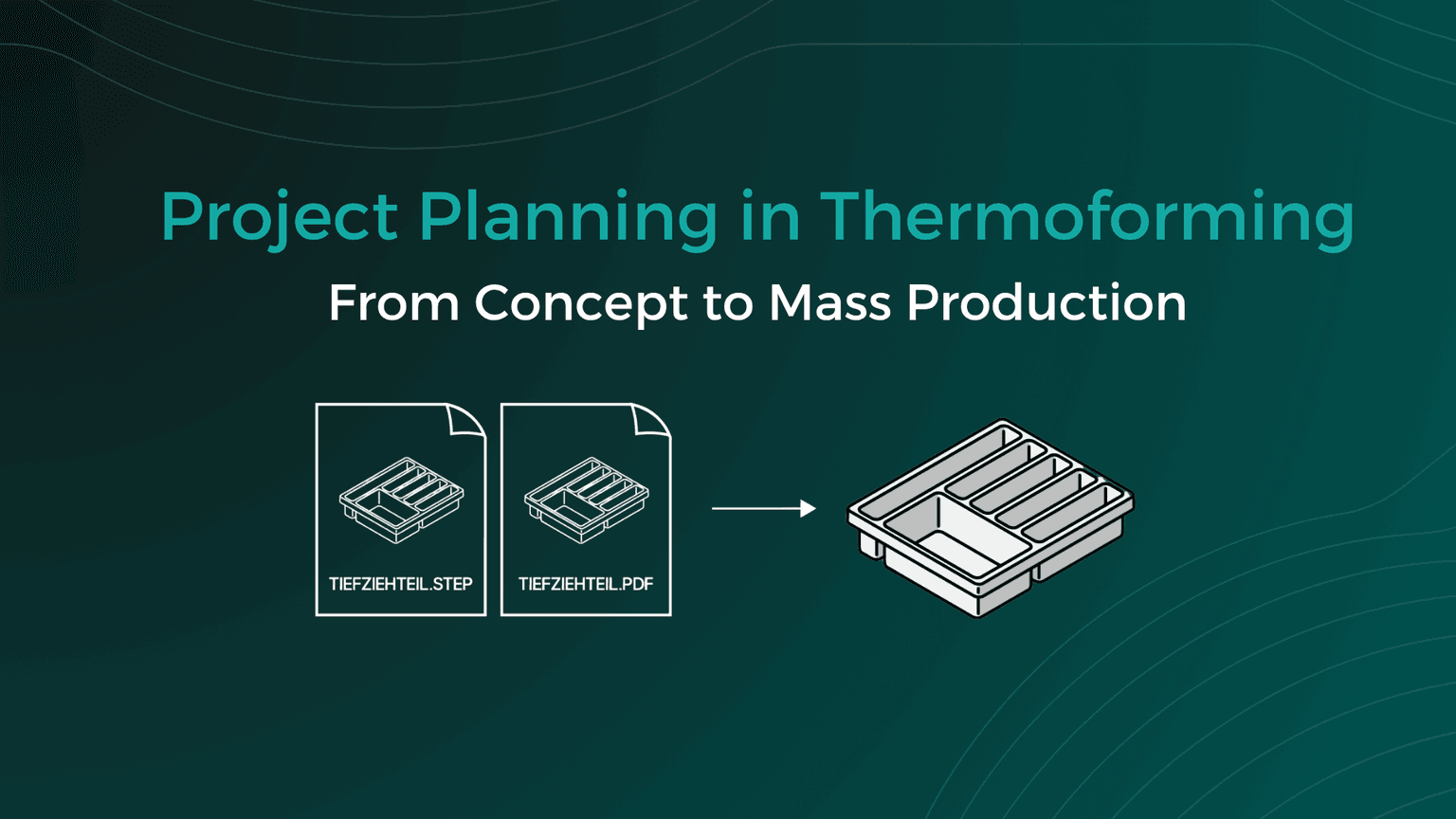
Project Planning in Thermoforming – From Concept to Mass Production
From the initial idea to mass production, various factors must be considered in thermoforming project planning, including material selection, tool manufacturing, and quality control. This article provides a detailed look at how a thermoforming project with formary is executed.
Thermoformed Parts in Practice
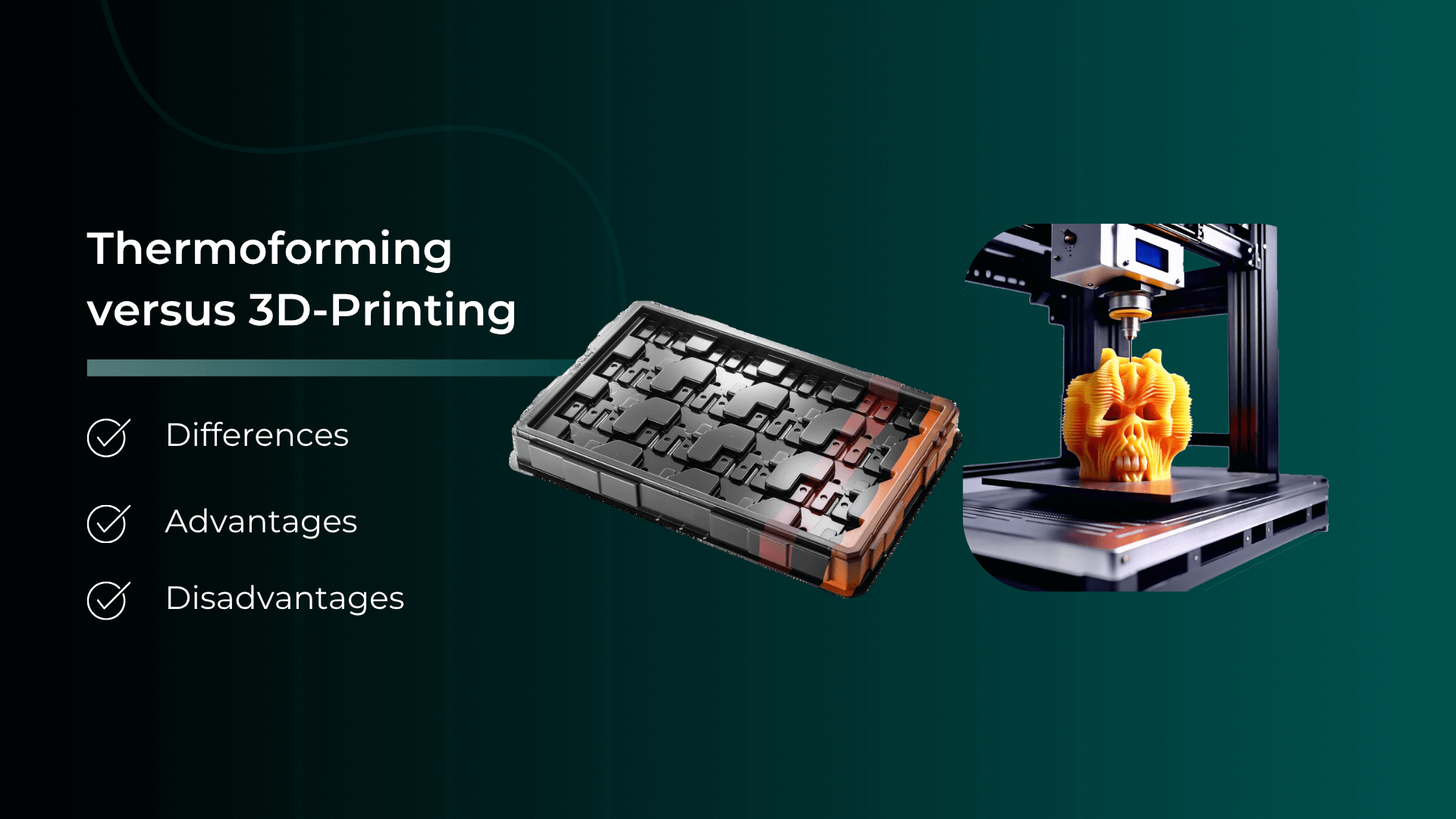
Thermoforming vs. 3D Printing – Advantages, Disadvantages, Differences, and Similarities
Plastic parts are manufactured using various processing methods. In this article, we focus on comparing the processes of plastic thermoforming and 3D printing.
Thermoformed Parts in Practice
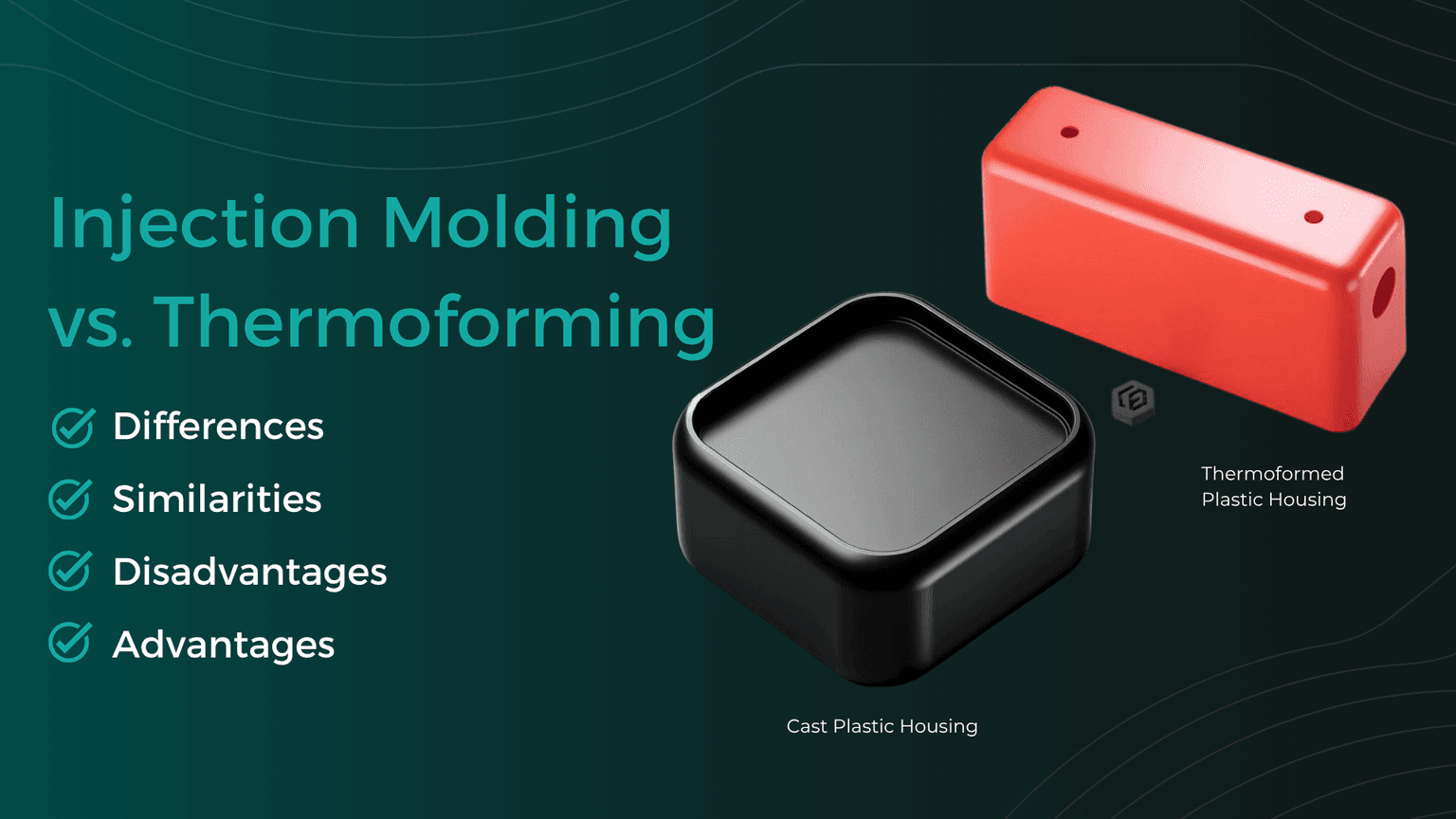
Injection Molding vs. Plastic Thermoforming – Advantages, Disadvantages, Differences, and Similarities
In the world of plastic processing, there are various common manufacturing methods used to produce precise plastic components for industrial applications. We compare two of them: Injection Molding and Plastic Thermoforming.
Thermoformed Parts in Practice
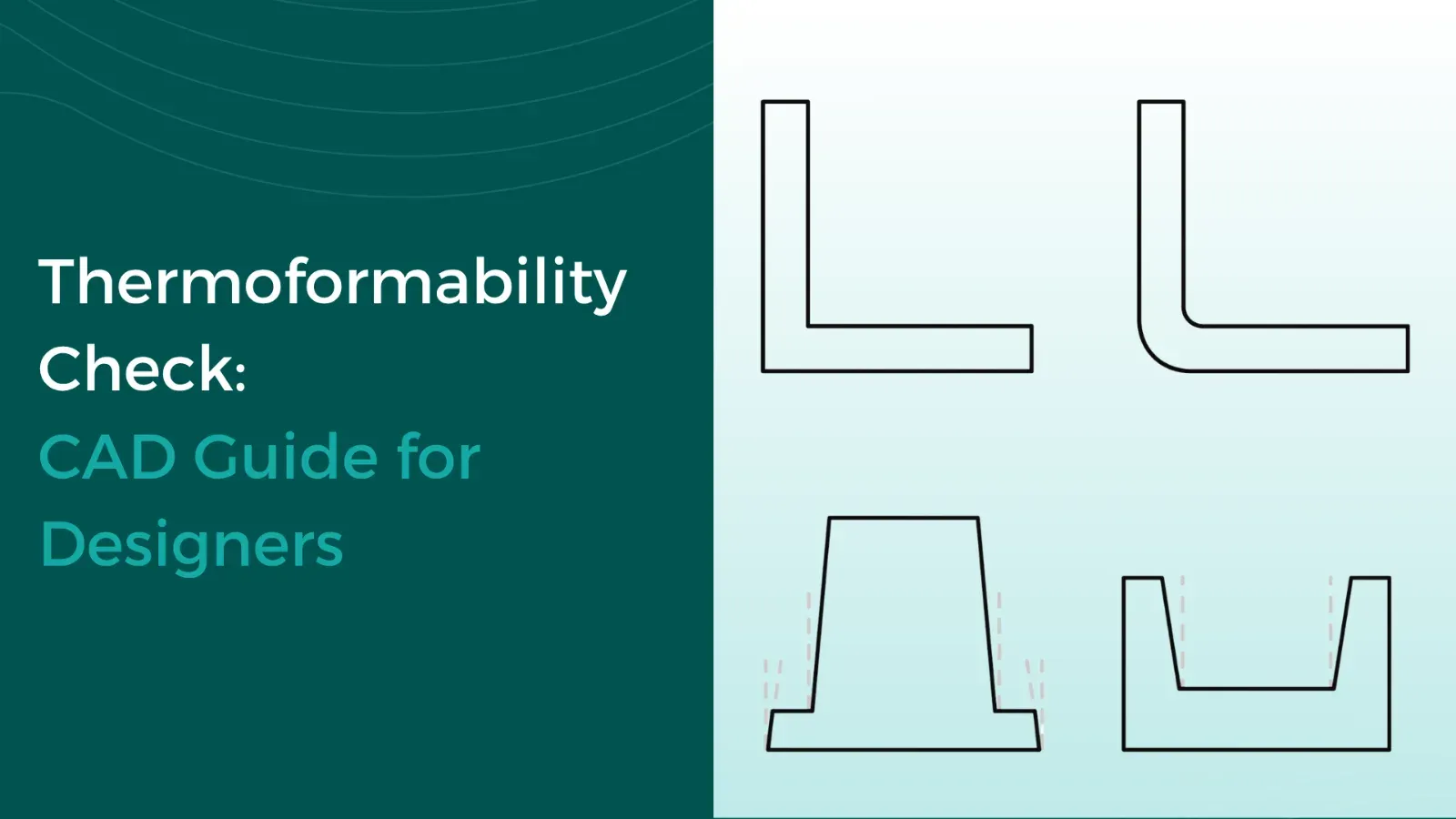
Checking CAD Models for Thermoformability: The Designer's Guide
Whether a plastic part is thermoformable is determined in the CAD model. Anyone who discusses geometry, wall thicknesses, and demoldability only after the first sampling pays for this loop with tool modifications, material waste, and lost weeks in the project timeline. This can be avoided during design: with a structured check that evaluates each model along this guide and makes typical sources of error visible early on.